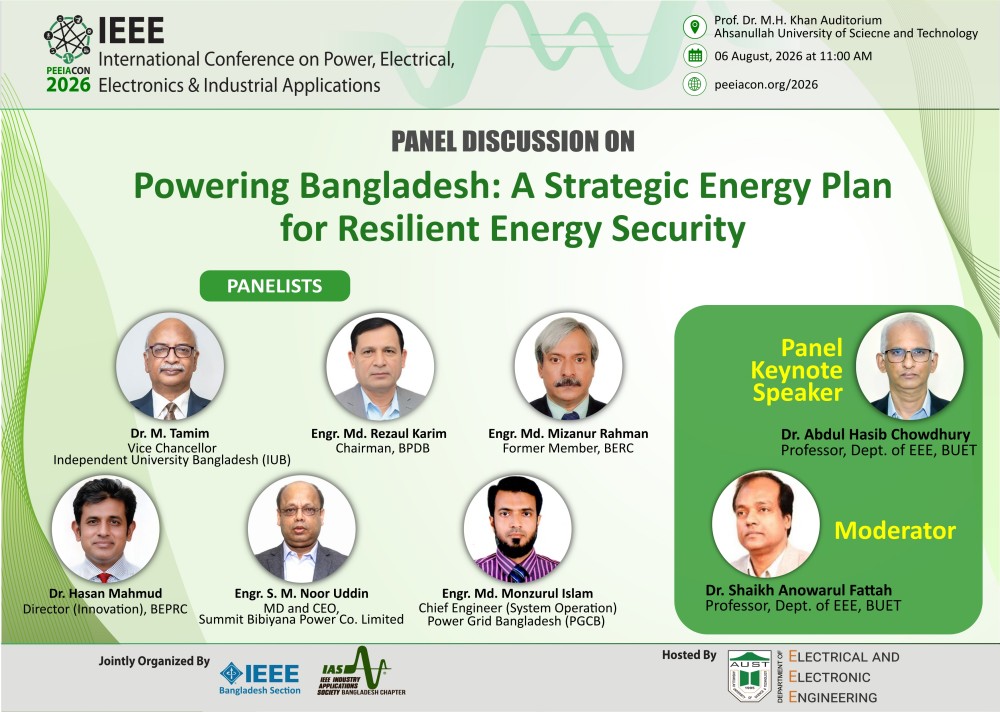
Time: 11:00am -1:00pm
Venue: M.H. Khan Auditorium, Ahsanullah University of Science and Technology
TOPIC - Powering Bangladesh: A Strategic Energy Plan for Resilient Energy Security
Panel Keynote Speaker
Dr. Abdul Hasib Chowdhury
Professor, Dept. of EEE
Bangladesh University of Engineering and Technology (BUET)
Honourable Discussants
Moderator
Dr. Shaikh Anowarul Fattah
Professor, Dept. of EEE
Bangladesh University of Engineering and Technology (BUET)
Abstract
As Bangladesh targets a $1 trillion economy by the mid-2030s, meeting future energy demand will require navigating structural economic shifts, changing sectoral energy intensities, and severe climate-related vulnerabilities. Projected electricity generation needs could reach 150–170 TWh with peak demand approaching 25–28 GW, necessitating an installed capacity of 35–40 GW. Achieving this trajectory demands a comprehensive evaluation of sectoral energy utilization across agriculture, industry, and transport, as well as addressing strict land-use constraints for power generation, transmission, and distribution. Furthermore, climate-induced stresses—such as El Niño phenomena—and localized operational risks necessitate a fundamental shift toward climate resilience, agricultural electrification, and resource diversification.
At the same time, critical structural and technical weaknesses continue to undermine the stability of the Bangladesh Power System. High dependence on non-synchronous sources, including reciprocating engines, solar PV, and specific HVDC power imports, leaves over 34–40% of installed capacity unable to provide inherent inertial support, resulting in sharp frequency deviations during supply disruptions. The grid’s weakly meshed, partially radial architecture and long transmission corridors heighten susceptibility to cascading failures, protection relay miscoordinations, and localized disturbances. To overcome these vulnerabilities, strategic priorities must center on modernizing grid infrastructure through enhanced primary frequency response, transitioning to fully meshed regional topologies, and scaling rooftop and high-density generation options.



 _
_  _
_